Research
Peer-Reviewed Publications
2026
-
 Who Likes Tracking? Evidence on Institutional Feedback in Education Policywith Flavia FossatiJournal of European Social Policy, 2026Forthcoming
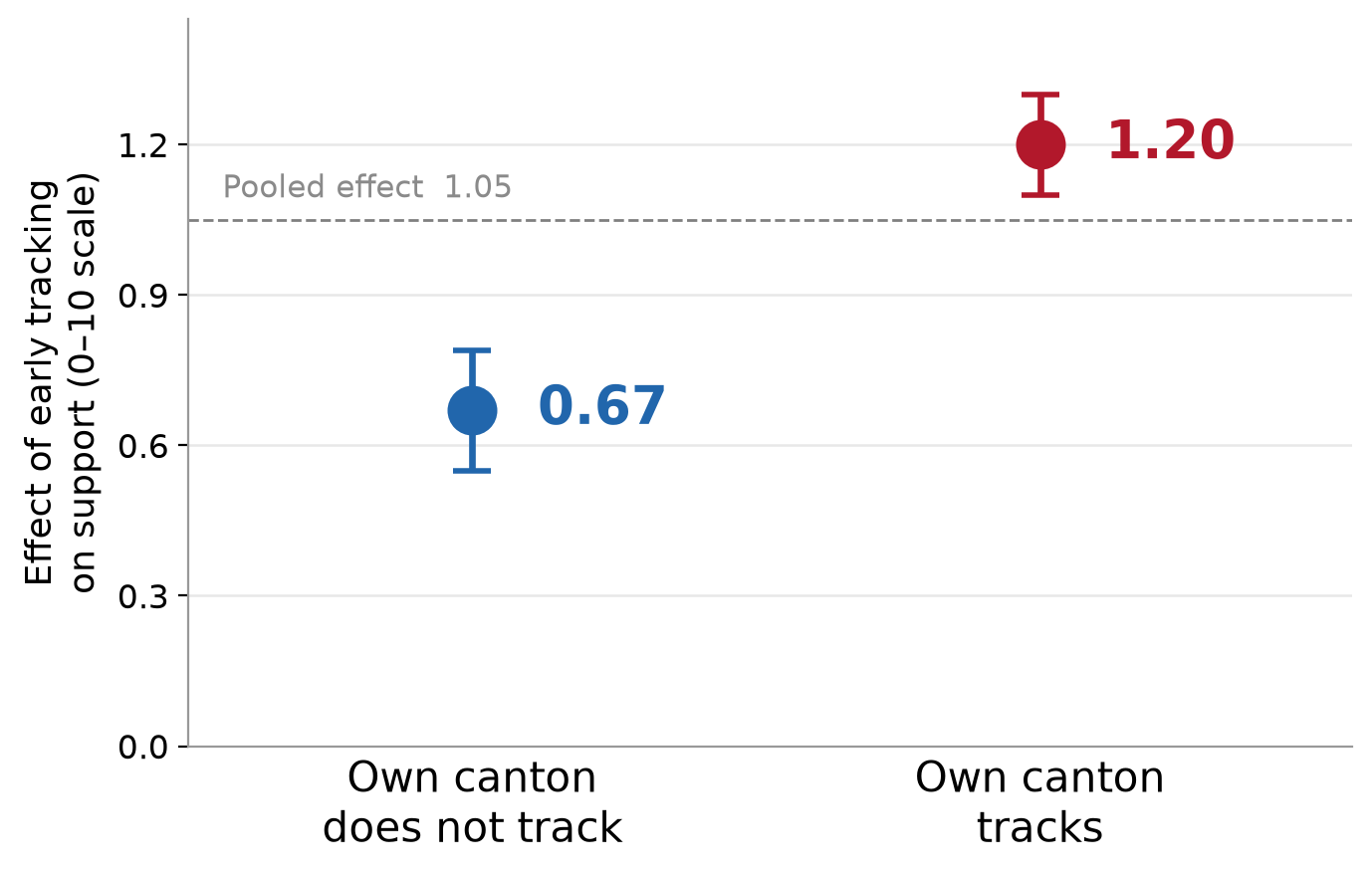
Education is recognized as a core component of the welfare state, yet we know little about how existing institutional arrangements shape public support for education policies. We test policy feedback theory in compulsory education, a policy domain where empirical evidence is still limited. Drawing on 4,382 Swiss citizens from eight cantons, we field an innovative visual vignette experiment using directed graphs that mirror official schematics of school structures. Respondents rate their support (0–10 scale) for fictitious education systems varying across seven policy dimensions that affect educational inequality. We focus on tracking, the fundamental structuring principle of education systems, and find that, first, tracking is indeed the most consequential attribute, raising support by 1.05 points. Respondents exposed to tracking in their own canton assign an additional 0.53 points to tracked systems, which is consistent with self-reinforcing familiarity feedback, as they show higher levels of support for the visible features of the system they live under. Second, support for tracking does vary by income, education, beliefs, and values while at the same time remaining positive across all subgroups. These patterns reflect boundary conditions of the familiarity channel rather than separate mechanisms. Third, other institutional features have comparatively modest effects, if any. Our results highlight citizens’ attachment to familiar policy designs and its implications for education reform, with broader implications for the study of education as social policy.
-
 Who deserves student finance? Results from a survey experiment in six advanced capitalist economieswith Eloisa Harris, Alyssa M. Taylor, Flavia Fossati, Juliana Chueri, Mia Katharina Gandenberger and Carlo M. KnotzJournal of Ethnic and Migration Studies, 2026
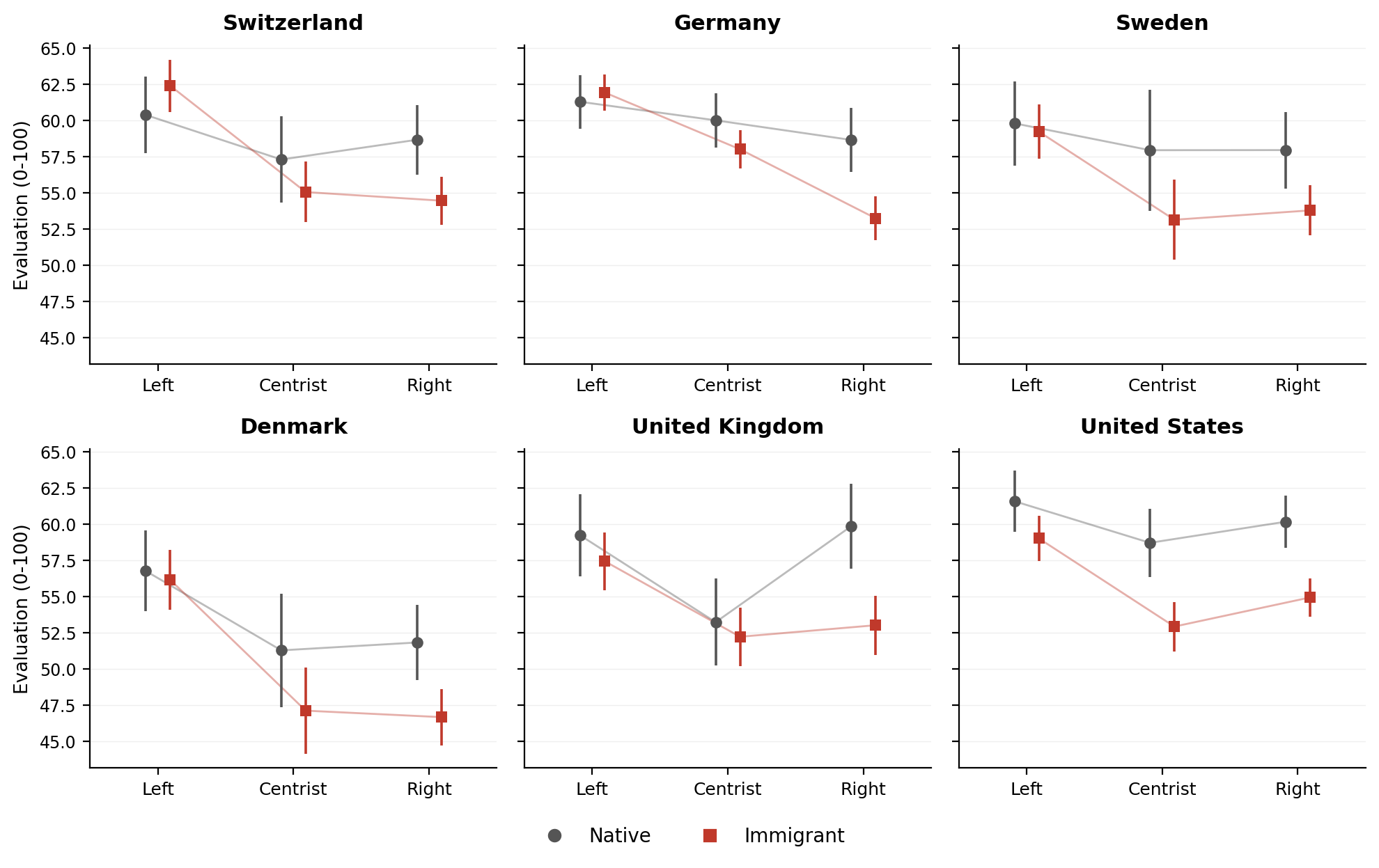
Higher-education policy is increasingly politicised across advanced western democracies, one important point of contention being the treatment of immigrant students, who are often portrayed as a ‘burden’ on higher-education systems. A second issue, made salient during the ongoing cost-of-living crisis, is students’ ability to make ends meet and the extent to which governments should provide them with financial support. While these issues are gathering scholarly attention, little is known about the demand side at the intersection of the two, namely, under which conditions immigrants are considered deserving of financial aid. We address this gap using data from original survey experiments conducted in six countries. Our main findings are twofold: First, immigrant students are generally evaluated as less deserving of financial aid than native students but can overcome this if they are top performers. Secondly, we find that this penalty for immigrant students is driven disproportionately by right-wing voters.


2024
-
 Cash-Based Interventions Improve Multidimensional Integration Outcomes of Venezuelan Immigrantswith Achim Ahrens, Marine Casalis and Dominik HangartnerWorld Development, 2024
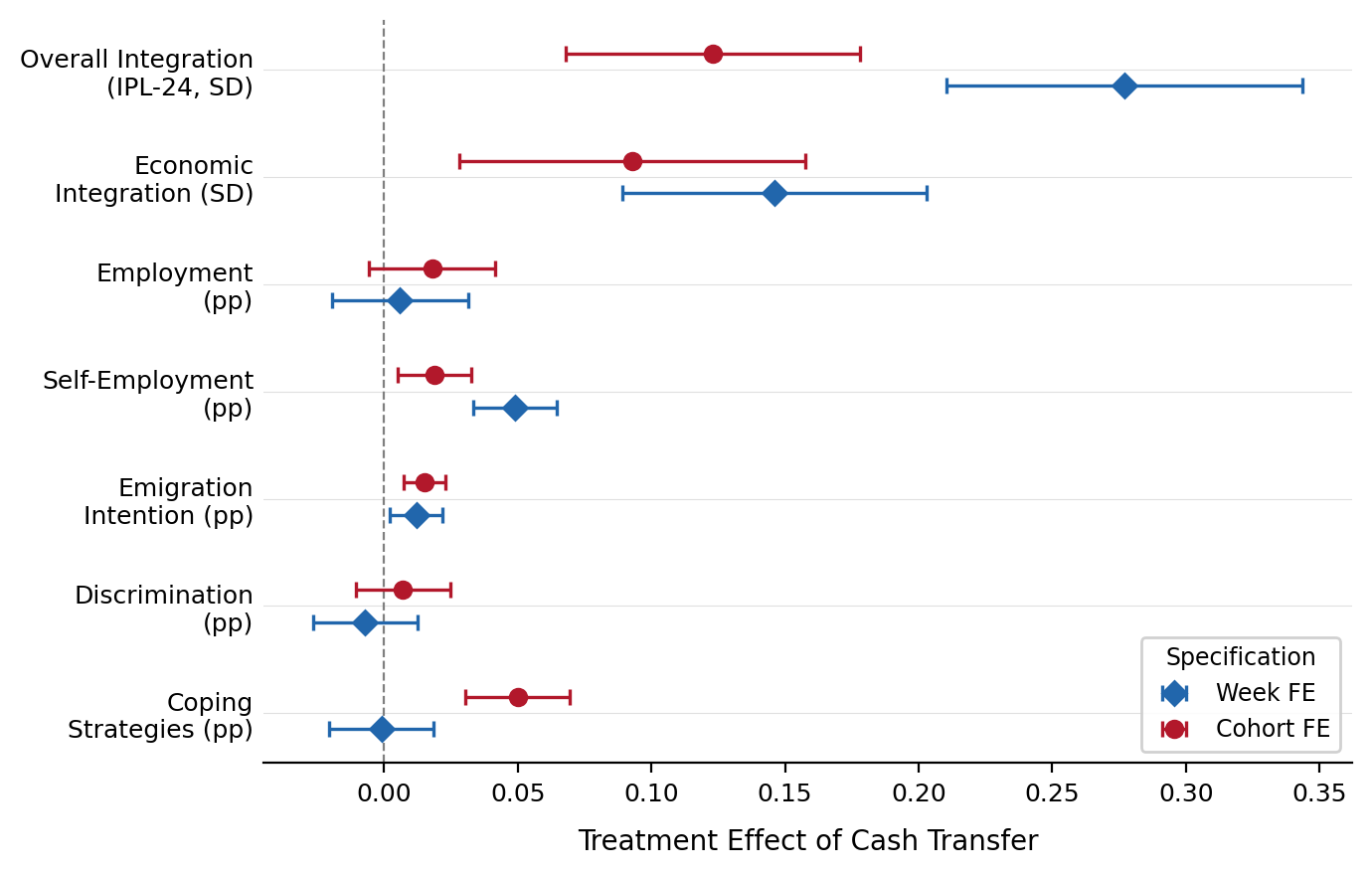
Since 2015, over 7 million Venezuelans have been forced to leave their homes, seeking refuge predominantly in neighboring countries across Latin America and the Caribbean. The displacement is typically accompanied by vulnerability and marginalization, yet there is a scarcity of actionable evidence on how to alleviate poverty among immigrants and refugees and facilitate their economic, political, and social integration. This study evaluates the impact of a cash-based intervention (CBI) on multidimensional integration outcomes of highly vulnerable Venezuelan immigrants, predominantly women, residing in Peru. Utilizing an original panel survey of beneficiaries and the staggered rollout of the program, which provided a one-time payment of 760 soles (approximately 190 USD or 74% of the monthly minimum wage), we estimate that the CBI increased the IPL-24 index – an overall measure of immigrant integration capturing several dimensions – by at least 0.12 standard deviations. Moreover, the CBI boosted self-employment by 2 percentage points and raised the intention to emigrate from Peru by 1.2 percentage points. Additionally, our heterogeneity analysis reveals that the benefits of the fixed-amount cash payment diminish significantly with the size of the household. We discuss how these findings inform the design of future CBI programs aimed at supporting vulnerable immigrant and refugee families.

Work in Progress
- Yes in My Back Yard? Deservingness and the Local Welcoming of Refugee Children in Switzerland2026R&R at Journal of International Migration and Integration
Refugee resettlement—and particularly where it happens—is politically contested, with host communities widely expected to resist the arrival of newcomers nearby: a not-in-my-back-yard (NIMBY) reaction. Yet the existing literature has focused on abstract admission targets among broad, undifferentiated groups, leaving open the question of how citizens respond when they evaluate a concrete, identifiable group of refugees—a scenario much closer to the reality of actual allocation decisions. This specific-case framing, I argue, triggers deservingness-based filtering, and I test it with a survey experiment in eight Swiss cantons (N = 4,756, December 2024). I randomized respondents into two groups, both asked to evaluate refugee children—with independently randomized nationality, parental SES, mental-distress evaluation, academic performance, legal status, and length of residence—in either their own school district or in a neighboring one. Three findings stand out. First, I find that support is 13.8% higher in the own-district condition than in the neighboring one—a YIMBY pattern, the opposite of the NIMBY reaction documented by prior abstract-admission designs. Second, Swiss respondents grant Ukrainian children a premium that is roughly twice as large when they are allocated locally (+0.30 versus +0.15 points on a 0–10 scale; interaction p < 0.05). Third, consistent with a deservingness logic, the premium comes mainly from restrictive respondents, who would otherwise filter on welfare or immigration grounds; more permissive respondents show no preferential support toward Ukrainian children. These findings add to the localized-resistance literature by pointing toward deservingness as the active mechanism in specific cases, shedding light on national-origin premiums that reflect selective restrictiveness as opposed to broad sympathy toward refugees.
- Access to Legal Information and Refugee Empowerment: Experimental Evidence from Greecewith Marine Casalis, Dominik Hangartner and Alexandra C. Hartman2025R&R at British Journal of Political Science
Can legal empowerment support forcibly displaced people facing high levels of violence and limited incentives to report? We study engagement with legal information and its downstream impact using a randomized encouragement design with 1,707 refugees and asylum seekers in Greece. At baseline, nearly half of participants were unaware of where to seek help after experiencing violence. We randomly encouraged access to either generic legal information via a website, personalized legal information delivered through WhatsApp, or a control condition. Take-up was higher for generic than personalized information. Relative to the control group, personalized information significantly improved knowledge of exploitation and confidence in responding to violence three months later, whereas effects of generic information were smaller and statistically insignificant. We find no detectable effects on more distant outcomes, including mental health and integration. Online trace data suggests that personalized conversations provide tailored guidance and referrals, highlighting a trade-off between scalability and effectiveness.
- Asylum Granted: The Integration and Well-Being Benefits of Obtaining Refugee Statuswith Marine Casalis, Dominik Hangartner, Alexandra C. Hartman and Joe Kendall2025R&R at World Development
How does a person’s immigration status shape well-being, integration and opportunities? Immigration status is particularly high-stakes for people fleeing persecution and violence, who may face uncertainty in their ability to reside legally and move freely. In many countries, the process of obtaining refugee status has become increasingly difficult and politicized. In this study, we address this empirical gap by combining administrative UNHCR records linked with an original panel survey of asylum seekers and refugees in Greece conducted between 2022 and 2023. We use a difference-in-differences design to identify the impact of refugee status on labor market outcomes, integration into host communities, psychological distress and onward migration. We find that obtaining refugee status from the Greek state reduces psychological distress and improves overall integration, with effects being mostly driven by navigational integration, while also increasing secondary movements within Europe. These results are robust to a variety of checks and specifications, providing evidence for the multidimensional impact of granting refugee status.
- The Hamas Attack and Immigration Attitudes in Europe2026Manuscript in preparation
Attitudes toward immigration can shift overnight after geopolitical shocks, yet the direction and magnitude of these effects remain debated—particularly for events that combine terrorism and interstate conflict. In this paper, I analyze how the October 2023 Hamas attack affected attitudes towards immigration in Europe, leveraging the overlap between the attack and ongoing European Social Survey fieldwork in 16 countries. With an unexpected event during survey design (UESD), I run OLS regressions with entropy balancing and find that the Hamas attack led to a negative shift in immigration attitudes, with the effects heavily concentrated on the consequences of immigration items (0.07–0.14 standard deviations) rather than on admissions into the country (0.05–0.06 standard deviations). The effects are present in 13 of the 16 countries for the culture and better-place items, and are robust to an extensive battery of robustness checks. In addition, I run a comparative analysis with the Russian invasion of Ukraine and find that the war led to an opposite, pro-immigration shift in attitudes, suggesting that the direction of the effects is more nuanced than previously understood. The findings in this paper show that geopolitical crises do shape public opinion on immigration but are harder to predict ex ante.
- Beyond Left and Right: Locus of Control and Education Policy Preferenceswith Flavia Fossati2026Manuscript in preparation
Left-right ideology and partisanship are the standard predictors of policy attitudes in political science. In this paper, we argue that locus of control—a non-cognitive trait capturing individuals’ viewpoint on whether life outcomes are a result of personal effort or external forces—is an independent predictor for understanding education policy preferences. We use original survey data from 2,912 respondents in Switzerland with two conjoint experiments to show that individuals with high internal locus of control support tracked systems significantly more than individuals with low internal locus of control. Our findings also show that this effect is specific to tracking, the distinctive meritocratic feature of education system design, and does not extend to other education system attributes. We complement our analysis with a second experiment on refugee children’s allocation to schools, showing that individuals with high external locus of control are more sensitive to geographic proximity, preferring refugee children to be allocated in their own district as opposed to a neighboring one. Our results are robust to controlling for political ideology, party affiliation, and demographic characteristics. We present attitudinal evidence showing that the connection between locus of control and tracking reflects a broader meritocratic worldview: individuals with high internal locus of control perceive more equal opportunity in the education system, are more tolerant of income inequality, and tend to oppose redistribution. All four locus of control types are present across both the entire left-right political spectrum and all types of political parties, revealing within-ideology and within-party heterogeneity that standard political predictors miss.
- Swiss Teachers’ Education Policy Preferences: A Survey of Attitudes and Experimental Evidencewith Flavia Fossati2026Manuscript in preparation
Teachers are the frontliners of education policy implementation, yet little systematic attention has been paid to their policy preferences in political science. We conducted a survey of 301 compulsory-education teachers across French- and German-speaking Switzerland on six highly salient education reforms and six refugee integration policy domains. Our pre-registered survey experiments test whether teachers’ attitudes are malleable based on the nationality of refugee students and information provision treatments. Our findings suggest that teachers show high levels of support for both education reform and refugee integration. Surprisingly, neither the refugee nationality framing (Ukrainian vs. Afghan origin) nor the provision of policy-relevant information are strong enough to shift teachers’ opinions on any of the 12 items we tested. Most effects are zero or at best negligibly small, as confirmed by equivalence testing. Our null results suggest that teachers hold crystallized professional opinions, which may be the result of their direct experience with the policies we studied, and are therefore resistant to the kind of survey-based interventions that have been shown to move attitudes in the general population.
- The Effects of the November 2015 Paris Attacks on Labor Market Outcomes of Arabs and Muslims in the United States2025Manuscript in preparation
This paper examines the impact of the November 2015 Paris terrorist attacks on the labor market outcomes of Arabs and Muslims residing in the United States. Employing a difference-in-differences approach with the Current Population Survey’s monthly Outgoing Rotation Group files, I find significant short-run adverse effects concentrated in the first year after the attacks. Weekly hours worked for Arab and Muslim men declined by approximately 1.0 to 1.2 hours relative to all three comparison groups. Employment rates for Arab and Muslim men also fell by approximately 2 percentage points relative to other immigrants and US-born individuals. Arab and Muslim women experienced a short-run decline in weekly earnings of approximately 7% relative to all comparison groups; however, this effect is substantially attenuated when controlling for occupation and industry, consistent with occupational and industrial downgrading whereby affected workers shifted to lower-paying jobs. The long-run estimates are generally smaller and less precisely estimated, suggesting that the adverse effects were concentrated in the immediate aftermath of the attacks.
- Teachers as Gatekeepers of Equal Opportunity? Explaining Education Policy Preferences in Switzerlandwith Meret Lütolf and Flavia Fossati2026Data analysis in progress
- Faster Asylum Decisions and Refugee Integration: Evidence from Switzerland’s 2019 Asylum Reformwith Achim Ahrens, Laurenz Derksen and Dominik Hangartner2026Preliminary title; data analysis in progress